Showing posts with label Lake District. Show all posts

22 August 2016

70 years of opening at Hill Top

We're looking back to the 1940's to when Hill Top first opened to visitors:


Seventy years ago on July 7th, Hill Top opened to the public for the first time, after being left to the National Trust by Beatrix Potter.
Hill Top with the Coniston fells beyond


Beatrix wrote in her will:

That the rooms and the furnishings used by me at Hill Top farmhouse may be kept in their present condition and not let to a tenant and it is my wish that any other objects of interest belonging to me in any other of my cottages and farmhouses may be preserved therein.”


In 1944, whilst Britain was still at war and houses were not to be left empty, Ethel Hartley came to stay and created a notebook based on her conversations with William Heelis.

She wrote in her ‘Notebook of Ideas’ “It is a joyous task to be asked to live in Hill Top & in its atmosphere of peace & quiet, to listen: think: suggest: & help to plan for the day when the Beatrix Potter memorial can be completed.”

 
Beatrix and William discussed at some length how the house could be opened as a place of pilgrimage for those enjoyed the little books, and as an interesting example of Lakeland vernacular architecture.  Surviving his wife by only eighteen months, William was unable to put into action some of the plans they had discussed, some of which seem quite radical – for example, opening a Peter Rabbit tea garden, encouraging the Girl Guides to put on plays during the summer; and opening a shop: "Peter Rabbit books could be on sale, with postcards, calendars etc. All these would make money and go toward the upkeep” 

 
In 1946, the house did open to the public – with an entrance fee of one shilling. Mrs Susan Ludbrook was the first custodian and only member of staff.  It immediately became a popular destination leading Bruce Thompson to admit to Time Magazine in 1946:

“We need to be careful what we do about Hill Top’s propaganda: in the first seven weeks we have already had 1,200 visitors!”

In the early 1980’s the custodian was joined by a “houseman” and a couple of part time assistants. In 1992 the role of volunteer room-guide was introduced and we still have one or two of these original volunteers helping us!

We continue to evolve and adapt the needs of the house for the benefit of our visitors, using modern conservation techniques to monitor and protect its precious objects,  so Hill Top might remain a must see destination for visitors to the Lake District for the next seventy years.
Detail from the bedroom at Hill Top


“It was never intended to be just merely a lovely, old period farmhouse. It was essentially & will always remain Beatrix Potter's house. She loved pretty things & simple things, & odd things. In Hill Top she wanted to find a home for them all.” (Ethel Hartley)


As well as celebrating this special anniversary in 2016 we're also marking the milestone of Beatrix Potter's 150th Birthday. Find out more about the celebrations here and join in the fun! 


Words by Jane Watson


31 July 2015

B is for Beatrix and Birthdays :)


Beatrix and I have something rather special in common   - it’s both of our birthdays this month! By the time that this post goes up on the tinternet it will have already been Beatrix's. B’s is on the 28th and mine… it’s today! J
I wonder how B would have celebrated her birthday? I would like to think that she would have celebrated in some big way but really I think that she would have had a quiet one with William at her side. You may remember my first blog post, approximately 2 years ago now, when I wrote about Moss Eccles Tarn (and coincidentally lost my car keys whilst trying to take some photos of the water lilies). I told you how Beatrix would draw whilst William would row on the tarn, it sounds like a pretty idyllic day out on a summer’s day.

Last month I told you about my move to Townend and, well it’s happened, I’m here and I’m really enjoying it!

I found out a surprising connection between my newly adopted family, the Browne’s (who lived in and owned Townend) and Beatrix. Whilst doing a spot of research on the house and the family for my tour I found out that B would visit Townend when the last Browne, Clara, was living in the house.  We know that Beatrix went and had a look around the house and is known to have passed comment on Mr Browne's prized carvings. It is said that she called him “The tiresome Mr Browne” and that he had the outdated Victorian habit of over embellishment.

Clearly she wasn't a fan of the work he had put so much effort it to.. my Dad has a very similar opinion, he loves old furniture and antiques and doesn't like that someone has changed them... in his eyes, not for the better. Troutbeck however, he loves. But that's ok, we all have different opinions on things and that's what keeps things interesting.

If you have a spare hour or so I think you should definitely pop over to the house up in Troutbeck and come have a look around this Lake District gem for yourselves :) (Can you tell that I'm enjoying my time up here much?)

If you're anything like me summer will make you think of the sunshine, bbqs, eating outdoors.. ice creams (I'll look like an ice cream soon.. )and beer gardens.. but one thing I've been fancying recently is a spot of afternoon tea.

One of my favourite cups and saucers that Beatrix owned is this little set..

They're rather striking and have always taken my eye. And coincidentally I am told that they came back to Hill Top from Troutbeck Park Farm just up the road.

Officially this one is down as a coffee cup. I'm strictly a tea girl myself (the smell of coffee I can do, I can even handle a slice of coffee cake but the real stuff.. no thanks). However that doesn't put me off, I still love these with their gilt rims and painted flowers these pretty things were made by Royal Worcester in around 1870.

Saaucy..
Ironically I used to hate pink, I used to think it was a “girl’s colour”, yellow was my favourite colour and still is but now I love it and I love these! I don't think of myself as one of those olden day ladies by any means but I could just see myself having a cup of tea in the garden with these... and maybe a delicious scone as well.

With its new replacement handle this cup has certainly seen better days but on the flip side maybe it means that it's also been well loved and well used?
Cup Of Tea?!!
They date from approximately 1770 made in porcelain.. The original handle was replaced with a woven rush one at some point but when it was attached a crack appeared at the bottom. Do you think that the cup was dropped, overused, or maybe it was always a tad bit wobbly? I don't know, but whatever happened to it and wherever it comes from I think it's absolutely charming!

They are one of a pair and the other cup and saucer are in good health but I like this damaged two piece better.

Now, usually my usual “Heelllooee There” is something that I really like from the collection. This time it's awkwardly something that I don't like that much.

It's these two people! I don't know what the heck they are doing; I've always thought that they might be dancing? Gossiping? Or just generally hanging out.. I don't know what they are doing but like the previous cup and saucer they are one of a pair.

"Dancing in the moonlight.."
Think having two of these is a good thing? Na, it means there are two of the things to look at! Don't get me wrong, I would never try and hide them behind something so they can never be seen but personally, they're not my sort of thing...

They're Staffordshire and made between the late 19th and early 20th centuries.  Each ornament has both a girl and a boy; they have white hair painted brown, blue shoes and shells around the base... They're just odd haha. 

On that bombshell I'll be off.. (to London where we'll be celebrating my birthday :) ).

Have an absolutely fantastico weekend, I hope the sun shines where you are :)

Ta ta for now :)

Words and pictures by Natalie


26 June 2015

Travelling In Style!

Thinking about how to begin this month's post I realised that Beatrix and I have a few different things in common – a rather snappy dress sense, a thing for the sheeps (I am Welsh after all.. or at least that's my excuse) and we both have a bit of a thing for adventuring around and exploring new places.

Beatrix may never have ventured out of the United Kingdom but she sure got around, exploring a lot of different places within the country, something I love doing.
There are all kinds of journeys – long ones which require a multitude of snacks, small, little ones that zip past and those you remember for a variety of reasons.

If you have peeked at the Hill Top and Beatrix Potter Gallery's Facebook page over the last few weeks you will have seen that Michael Portillo brought his railway journey up to the lakes to see B and the team at Hill Top. 

He was here to find out more about Beatrix, her friendship with Hardwicke Rawnsley and the part she played in the formation of the National Trust. I was lucky enough to be able to see some of the filming at Hill Top. I didn't quite get my on screen debut just yet but watching it happen was interesting so keep your peepers peeled for it on the tele in the near future!

Micheal P may favour the railways for his journeys but this isn't the only way to travel check out this amazing ship that we have at Hill Top.

Land Ahoooyyy!
To say that I don't know much about ships is a huge understatement and my experience with them is pretty limited – unless rowing a small wooden boat on Durham River counts? With these long arms I'm practically made for rowing..
So to find out more about this vessel I've done what all good detectives would do... I googled!

This is a three masted ship and apparently made by a sailor between 1870 and 1900-ish. From my research (aka scrutinizing lots of images of ships) I'm going to make an educated guess and say that this is a type of schooner? These are sailing vessels with two or more masts often designed for trades that required speed and windward ability.. trades like, pirating, “Ohh Arrrg!”
With all those sails I imagine that it would have had no problem zipping through the waves or lakes!

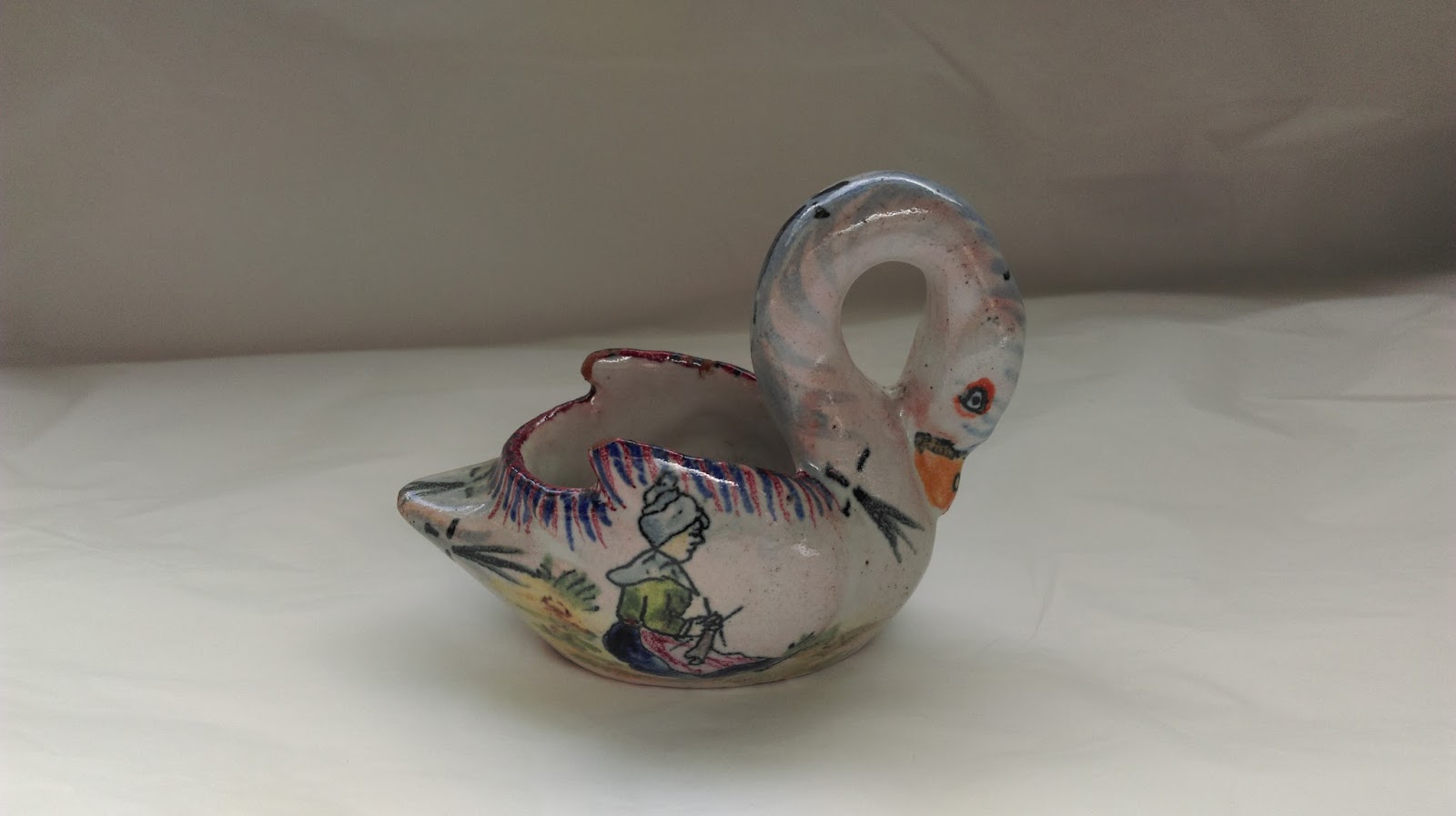
A slower, more sedate, unconventional and downright feathery mode of transport is this month's
“Heeeellooooe There!”.

Sure maybe you wouldn't want to use him for long journeys, mainly because he is extremely dinky in real life and to be honest he's a bit out of practice after having been in a cabinet for such a long time.


I know what you're thinking, “A swan is not a mode of transport!” but I would counter this with, “Have any of you seen Doctor Doolite?” the original of course... He had this amazing great big pink sea snail and no one questioned this as a mode of transport when it was time for Emma to head back to London! I absolutely love this film, but back to the swan :)

With a fleur-de-lys painted on one side of his body and a lady in traditional dress knitting on the other it could have possibly been produced by Quimper Faience in Brittany, France. This pottery's design reflects a strong traditional Breton influence and a lot of the older pieces are strongly sought after.
Luckily for us this little guy is staying firmly at Hill Top!

This year's top model pose..
He may be petite but he wears some pretty flamboyant eye makeup.. I mean red eyeliner? That's a bold statement but he is definitely working this look. I myself might give it a miss, with my extremely pale skin I worry I'd end up looking scary rather than spectacular!

Whether you choose a ship or a swan to complete your journey you'll need to have a general idea of which way to go, don't you?

This is down as an ornament on our inventory, it lives in the ivory cabinet but to be honest I'm not completely sure of it's actual purpose or even if it has one..some things are 'just because'.
What are your thoughts on it? 


The hand in the middle twizzles around and to me could point you in the right direction – in my mind the numbers could even be routes? (Does this make any sense or is it just something in my mind??)
My other thought about it was that it reminded me of the big hand from the old lottery adverts.. 

“It could be you!!!”
Anyway I digress, this object came from London and is marked on the bottom ‘H Rodrigues, 42 Piccadilly, London’ – but apart from that we can only guess about its history. Could this have some to Beatrix from her parents or grandparents along with the other bits and bobs of ivory?

My own history with Hill Top and Beatrix has only been relatively small; about 2 and a bit years (ish) but like Beatrix I’m going on another little journey of my own.
I’m happy to say that I’ll be working over at Townend from mid-July until the end of October on a little secondment

However, never fear, this isn’t farewell, we all take different paths on our journeys and you’ll still find me strutting my stuff up and down B’s path one day a week.


There is actually a little connection with Beatrix and the Browne’s of Townend but more of that next week!

See you all in July!

Ta ta for now

Words and photos by Natalie

27 March 2015

Field and Farms Forever??

How the landscape Beatrix Potter loved came to be.

It's easy to understand why Beatrix Potter, like many others, fell in love with the Lake District.  The pattern of undulating fields and stone walls sprinkled with farmhouses and woodland, along with the quaint villages and quiet tarns, give it a special feeling of intimacy.  This is set against the grandeur of the fells - when they don't disappear mysteriously into the clouds!
Fields around Near Sawrey  showing Castle Cottage where Beatrix Potter lived as Mrs Heelis

Moss Eccles Tarn above Near Sawrey

However, the landscape, even that of the high fells, is largely man-made and would have been woodland.

People started to change the look of things in the Neolithic (around 6,000 years ago).  Polished stone axes from Great Langdale became the 'must have' gifts exchanged by the upper classes across the country.

The sporadic woodland clearance became more extensive in the later Iron Age (say 300 BC to Romans).  Recently (I mean that - about 2013!) an observant boy found a strange piece of metal in a hedgerow near Hawkshead.  Not convinced that it was a bit of junk, he took it to Kendal Museum and it proved to be an Iron Age sword!  Esthwaite Water was probably larger then so the sword might have been ritually broken and thrown into the water as a gift for the god.
Iron Age sword - broken intentionally (Kendal Museum)
From around AD 300 and through the early medieval the climate became warmer and drier - sorry, you missed it!  The Lake District would have been patched with cereals, grown for food, and blue flax and hemp mainly for their fibres.  No, they weren't all high on cannabis!

The many 'thwaite' names, Norse for 'clearing in a wood' suggests that more woodland was cleared under the Danelaw.  Hawkshead's name derives from the Norseman, Haukr, who had his dwelling, Saetr, there.  Sawrey, a muddy place, had its first mention in 1336 as Sourer and Esthwaite Water is literally the 'water by the easten clearing'.

After AD 1000 more trees went and in the late medieval sheep ruled as there was money in wool and monasteries (in this area Furness Abbey) practised large scale sheep farming in the uplands.  The Court House in Hawkshead served as the administrative centre for this area.  If you want to find out more and look inside, call in the National Trust Hawkshead Corner shop for the key.
The Courthouse, Hawkshead


After the Dissolution of the Monasteries in the 16th century, Hawkshead developed as a market town and many of the buildings, including the one which houses the Beatrix Potter Gallery and retains many original features, date from this time.  The name 'Rag, Wool and Putty Street' reminds us that much of the 'industry' would have been based on animal products and the air redolent with more pungent odours than that of roast dinners!
Leather, Rag and Putty Street, Hawkshead
Stone walls make good barriers, and shelter, where hedges might be hard to establish and useful places to put stones cleared from the fields.  In medieval times, ring garth walls marked the open fell from cultivated vally bottoms.  Cultivated land was divided as feudalism gave way to individually farmed land.  Finally, the Enclosure Movement of the 18th and 19th centuries led to the long walls crossing even the most forbidding areas of the high fells.

In the late medieval there was a 'Little Ice Age' (ending around AD 1700 but persisting in Hill Top ticket office) which contributed to the spread of mire and acid grassland.
Sam particularly likes mud! (and moves too fast for my camera action)
From AD 1600 to AD 1900 coppicing for charcoal has left patches of overgrown or managed coppiced woodland in which oak and other species may be encouraged to regenerate.

For more on how we're caring for the landscape now, check out the Rangers' blog.

5 September 2014

The Hill Top 5

From Tony Blackburn to Fearne Cotton, whatever age bracket you fall into I am sure that you remember listening to one music countdown or another, therefore I am sure the format of this month's 'Behind the Scenes' blog should be fairly familiar - No need to panic just yet, Pete. I'm not going to include any musical links in my post.

Instead of counting down musical entries I am going to count down the top 5 items that the public and our lovely visitors ask about on a daily and weekly basis.
The ones that you will read about are all contenders for the top spot but only one can win the coveted position. Are we ready? Here we go!

At 5 is a firm favourite.
It's the bittern! This fellow has taken up an elevated position and stands upon the aptly named 'Bittern Bureau' – a coincidence? I think not!

He is often mistaken for a heron but this guess isn't too far off, both are after all, wading birds. It's widely accepted that Beatrix had a passion for natural history so I don't think it's too odd that she had this little chap at Hill Top. Where she got it from however or from whom, well, that is another matter entirely.

What lovely long legs you have...

Holding strong at 4 are the set of 5 oil paintings that are hung in the New Room, painted by Bertram Potter (Beatrix's younger and rather talented brother) which were given to her as gifts.

From looking at them I bet you can guess what the comment we receive most often is, “Oh my gosh! Aren't they dark!” And yes, they are pretty dark, and to be honest they aren't my most favourite things in the house ('Crikey' you're thinking, one thing she doesn't want to take home!) B must have liked them and perhaps even had a little pride in the fact that her little brother had such a love for art. 
If I had to choose the one that I liked the best, it would have to be this one entitled 'Scene in a Pine Forest with a Stream' – err... catchy title, eh?!

Just look at the size of these whoppers!

Totally overshadowed by Beatrix, Bertram wasn't a terribly famous artist and these aren't his best work. Like Beatrix, he had an immaculate eye for detail, something I hope you'll take my word for.

Number 3 on our countdown is something that I haven't been asked much about this season although I'm sure that my colleagues might have had a different experience and disagree with me.
Here they are, essentially pieces of wood held onto the underneath of a beam with a bracket.


Just hanging around

One rather hilarious suggestion I've received for their use is for exercise, namely pull ups! Can you imagine B doing them? I won't tell you what other bits of furniture that people have suggested could be used as workout equipment but there have been a fair few.

So what are these things? In fact, the truth is far less amusing but no less interesting. They are shelf supports and in another life they would have held up planks of wood. Upon these you would have been able to store things, or perhaps you would have out  food up there to cool after cooking. We like to joke that we keep our choccy biscuits up there away from potential critters!

I'm going to take a small intermission at this point to introduce this month's..
“Hello there!”
There is a poodle in the Sitting Room cabinet who is so. Weird. I'm sorry to say it but I think it is, I don't even know why I like it (but I do :) )... And he's rude, look at this, he's turned his back to us.


Does my bum look big like this?

To be fair it's not totally his fault, he spins around in the cabinet because of the vibrations from the floor caused by all our visitors feet.
He is made of porcelain, is in the style of Chamberlain of Worcester and dates back to the early 19th Century.
He's just one of the doggy ornaments, figures and pictures in Hill Top. B had several dogs herself throughout her lifetime, perhaps they came second to her beloved rabbits? See how many you can spot on your next visit to Hill Top!

Back on with the chart!
Climbing high at 2 are the plates on the kitchen wall.


How similar the subject matter is to Beatrix's. In spite of the similarities, they were not painted by her but her father Rupert Potter – it seems art was a family affair.
By all accounts he was quite the talented amateur artist and had a great enthusiasm for art and photography. I like to think that B got some of her natural talent from him as well as her love for painting animals, although there is no denying that her work is much finer.


These pretty plates have been transfer printed and given to Beatrix as presents during her childhood, hanging on her wall in Bolton Gardens, her childhood home, it is no wonder that they have a special place in her first and favourite Lake District home.

Soo.. before we find out what the most asked about object at Hill Top is, here are numbers 5 – 2.
At 5, it's the long legged Bittern.
At 4 are the enormous paintings in the New Room.
3's just hanging around, it's the shelf supports.
2 are Rupert's plates that have pride of place on the kitchen wall.

On today's countdown the number one spot goes to.. (drum roll please)

The clockwork roasting jack!
Hanging next to the range this beautiful brass object gets a lot of attention on any given day at Hill Top. This interesting machine rotates the meat roasting from it's hook and aims to cook it evenly on all sides by rotating clockwise and then anticlockwise and so on.


I've heard it called a bottle jack, I don't know how true this is as my dad hasn't heard of it before (and he is the go to man when talking antiques!) but it's said the name comes from it's shape – like a wine bottle.

Unlike many people, I originally thought that it's hook was for cheese (don't ask me why I thought this, to this day I still don't know what was going through my mind) but my friend and colleague, Jane, pointed out that this was ludicrous resulting in a little light teasing every so often.
Unfortunately we don't have the key so we do not know how it runs or if it even still turns.

In spite of this, I think it's totally gorgeous and would have it in a second!


Wow, what a range of objects in our countdown and this week's blog.
You never know, the top 5 might move around a little bit by next year, it's all up to you, our visitors :)

As always I hope you have enjoyed reading this broadcast, come back next month for more 'Behind the Scenes' action where I will be talking about what we actually do when we are closed on a Friday and over winter :)


Ta ta for now


Words and pictures by Natalie :)
(With a little antique advice from my Dad)

12 July 2013

Frequently (and not so frequently) asked questions

What does everybody need when they arrive somewhere after a long journey?  You've guessed !

Question:  Where are the toilets?
Answer:  They're in the garden, half way up on the right hand side but subtly hidden and you may be distracted by the garden!


The Toilets 

The garden
And a not so frequently asked question- but it does happen!
Question: How long have you lived on this island?
Answer: We just get the map out for this.
Crossing to the 'island'
Question: Where was Beatrix Potter buried?
Answer: Beatrix was a very private person.  She was cremated and her ashes were scattered by her shepherd, Tom Storey, in a secret location.

Question: When is the quietest time to visit?
Answer: A hard one.  Generally it's quieter in the afternoons but at very busy times you may find we've sold out.  Saturday and Sunday afternoons are often surprisngly quiet.

Question: The car park's full.  What should I do?
Answer: A few options: - You could come back in a little while when there may be spaces - but please don't wait on the road.
There's a car park in Far Sawrey.  The 30 minute walk along the off road footpath gives you a great rural introduction to Hill Top.

If you click on this you should see a bigger version !
 There's more parking, and a Beatrix Potter trail, at the Esthwaite Fishery pay and display car park round the bottom end of Esthwaite Water - about 40 minute walk up.
National Trust car park at Ash Landing by the shore of Windermere and a lovely walk up - mainly off road and takes about an hour.
Sam on the footpath from Far Sawrey
Question: Referring to the Windermere car ferry - can I buy tickets for Ireland on the ferry?
Answer: Another one for the map!

Question: We've got some time to wait before going into the House.  What can we do?
Answer: Sawrey House Tearoom and the Tower Bank Arms pub can provide you with sustenance.  There's an excellent children's play area with picnic tables just down the road.  The walk to Moss Eccles Tarn, following in Beatrix's footsteps (it was one of her favourite places) takes about an hour. Go beyond the tarn to get fantastic views over to the Langdales.
Alternatively, you could get tickets for later in the day and fit in a visit to Wray Castle or the Beatrix Potter Gallery.

Play area

Sawrey House terrace

Moss Eccles Tarn
Water Lilies were Beatrix Potter's favourite flowers.  She planted a white one and a pink one in Moss Eccles tarn and they have since spread!  On her birthday, 28th July, we pick some from the tarn for the House
Question: Which is the nearest Underground Station? - Yes, it happened!
Answer: We'd guess Watford but ........ unless you're talking rabbit burrows of course!


Ticket Office Team

15 February 2013

Valentines Day 1913/2013

On Valentine's Day in 1913, Beatrix was already engaged to William Heelis, though a formal announcement had not been made due to pressures from Beatrix's parents because they did not entirely approve of their daughter marrying a country solicitor.

On Valentine's Day in 2013 matters are conducted in an entirely different manner... romance was definitely in the air!

In Mr Macgregor's garden at Hill Top at noon, Jason Birch asked his girlfriend, Vicky Boyes to marry him. She said yes and all the staff did a collective sigh of relief! We all approved of Vicky marrying Jason! Particularly as Vicky is a big Beatrix Potter fan.

Jason and Vicky went to explore the house and when they came out of the front door staff had a big surprise for them.... sparkling pink bubbly and a bag of Peter Rabbit goodies.

 Jason and Vicky looking very happy outside Hill Top with their celebratory drink of pink bubbly

Vicky's gorgeous ring - diamond solitaire in a white gold band

As the sun was shining, Jason and Vicky followed in Beatrix's and William's footsteps and went for a walk round Moss Eccles Tarn before returning for an overnight stay at the Tower Bank Arms. Wouldn't it be wonderful if they set the date for 15th October - 100 years to the day when Beatrix and William married in London.

Congratulations to both Jason and Vicky - we all hope you will be very happy!


12 October 2012

Step back in time...

If you're the sort of person who loves old photos then there's a treat available at Wray Castle as wonderful photos of the Lake District taken in the 1930s, 40s and 50s are on show until Xmas.

A 'lumber-jill' getting stuck in; don't like the look of that tree though!
This is a wonderfully evocative view of the Lakes in days gone by
 They are the work of one very talented man Kenneth Shepherd who recorded a way of life now all but gone. He wanted his photographic record to be looked after for the future and gifted his original glass plates to us here at the National Trust.

Harriet carefully dusts of the glass plate, you can see her at work in the video too
The project we're working on currently at Wray Castle, which visitors can see, has two aspects: to conserve the original glass plates for posterity (they are an invaluable resource for any future Lake District historian) and to make Kenneth Shepherd's photos available to the public - initially with our display at Wray Castle and in time on-line at our National Trust collections website.

And we'd like your help... If you knew the Lake District in days gone by or have a family or other connection with the area then you might just be able to give us information to help identify people and places in the photos. The photos which we've already scanned are up on the walls inside Wray Castle with the opportunity for you to add your information.

Wray Castle is open every day until Sunday 4th November and then weekends until Xmas so do come and see the photos for yourself.

Here's a short video about Kenneth and our conservation project, narrated by Kenneth's daughter, Rosemary and our curator Sarah.


Photos by Ken Shepherd (not to be used without permission).
Post by Linda
Video | photography by ward
Conservation photo | Jo Hudson