Showing posts with label Hawkshead. Show all posts

27 March 2015

Field and Farms Forever??

How the landscape Beatrix Potter loved came to be.

It's easy to understand why Beatrix Potter, like many others, fell in love with the Lake District.  The pattern of undulating fields and stone walls sprinkled with farmhouses and woodland, along with the quaint villages and quiet tarns, give it a special feeling of intimacy.  This is set against the grandeur of the fells - when they don't disappear mysteriously into the clouds!
Fields around Near Sawrey  showing Castle Cottage where Beatrix Potter lived as Mrs Heelis

Moss Eccles Tarn above Near Sawrey

However, the landscape, even that of the high fells, is largely man-made and would have been woodland.

People started to change the look of things in the Neolithic (around 6,000 years ago).  Polished stone axes from Great Langdale became the 'must have' gifts exchanged by the upper classes across the country.

The sporadic woodland clearance became more extensive in the later Iron Age (say 300 BC to Romans).  Recently (I mean that - about 2013!) an observant boy found a strange piece of metal in a hedgerow near Hawkshead.  Not convinced that it was a bit of junk, he took it to Kendal Museum and it proved to be an Iron Age sword!  Esthwaite Water was probably larger then so the sword might have been ritually broken and thrown into the water as a gift for the god.
Iron Age sword - broken intentionally (Kendal Museum)
From around AD 300 and through the early medieval the climate became warmer and drier - sorry, you missed it!  The Lake District would have been patched with cereals, grown for food, and blue flax and hemp mainly for their fibres.  No, they weren't all high on cannabis!

The many 'thwaite' names, Norse for 'clearing in a wood' suggests that more woodland was cleared under the Danelaw.  Hawkshead's name derives from the Norseman, Haukr, who had his dwelling, Saetr, there.  Sawrey, a muddy place, had its first mention in 1336 as Sourer and Esthwaite Water is literally the 'water by the easten clearing'.

After AD 1000 more trees went and in the late medieval sheep ruled as there was money in wool and monasteries (in this area Furness Abbey) practised large scale sheep farming in the uplands.  The Court House in Hawkshead served as the administrative centre for this area.  If you want to find out more and look inside, call in the National Trust Hawkshead Corner shop for the key.
The Courthouse, Hawkshead


After the Dissolution of the Monasteries in the 16th century, Hawkshead developed as a market town and many of the buildings, including the one which houses the Beatrix Potter Gallery and retains many original features, date from this time.  The name 'Rag, Wool and Putty Street' reminds us that much of the 'industry' would have been based on animal products and the air redolent with more pungent odours than that of roast dinners!
Leather, Rag and Putty Street, Hawkshead
Stone walls make good barriers, and shelter, where hedges might be hard to establish and useful places to put stones cleared from the fields.  In medieval times, ring garth walls marked the open fell from cultivated vally bottoms.  Cultivated land was divided as feudalism gave way to individually farmed land.  Finally, the Enclosure Movement of the 18th and 19th centuries led to the long walls crossing even the most forbidding areas of the high fells.

In the late medieval there was a 'Little Ice Age' (ending around AD 1700 but persisting in Hill Top ticket office) which contributed to the spread of mire and acid grassland.
Sam particularly likes mud! (and moves too fast for my camera action)
From AD 1600 to AD 1900 coppicing for charcoal has left patches of overgrown or managed coppiced woodland in which oak and other species may be encouraged to regenerate.

For more on how we're caring for the landscape now, check out the Rangers' blog.

25 July 2014

Exploring the Lake District by foot, bus, bike and boat with Peter rabbit

The Lake District is full of options for people wishing to leave their cars behind.  You really don't need to be an athlete to explore the countryside without a car.  Buses, bikes and boats allow everyone to enjoy the view and avoid congestion on the narrow roads.
 We have explored one of these possibilities with a very famous character; Peter Rabbit.  Peter wanted to follow in the steps of the woman who created him and learn more about her life, talents and legacy as well as seeing her home and many of his friends.

Peter was staying on the Eastern side of Lake Windermere near Bowness and so he decided to set out on his journey by boat.  First decision - whether to get the passenger ferry from Bowness or the car ferry from Ferry Nab.  Owing to Beatrix Potter's connection with Cockshott Point he decided to lollop a few steps south and get the car ferry.  It runs every 20 minutes and takes cars, bikes and pedestrians (and horses).

The next step can be done on foot or by bike or bus.  Peter tried bike but couldn't quite reach the pedals!

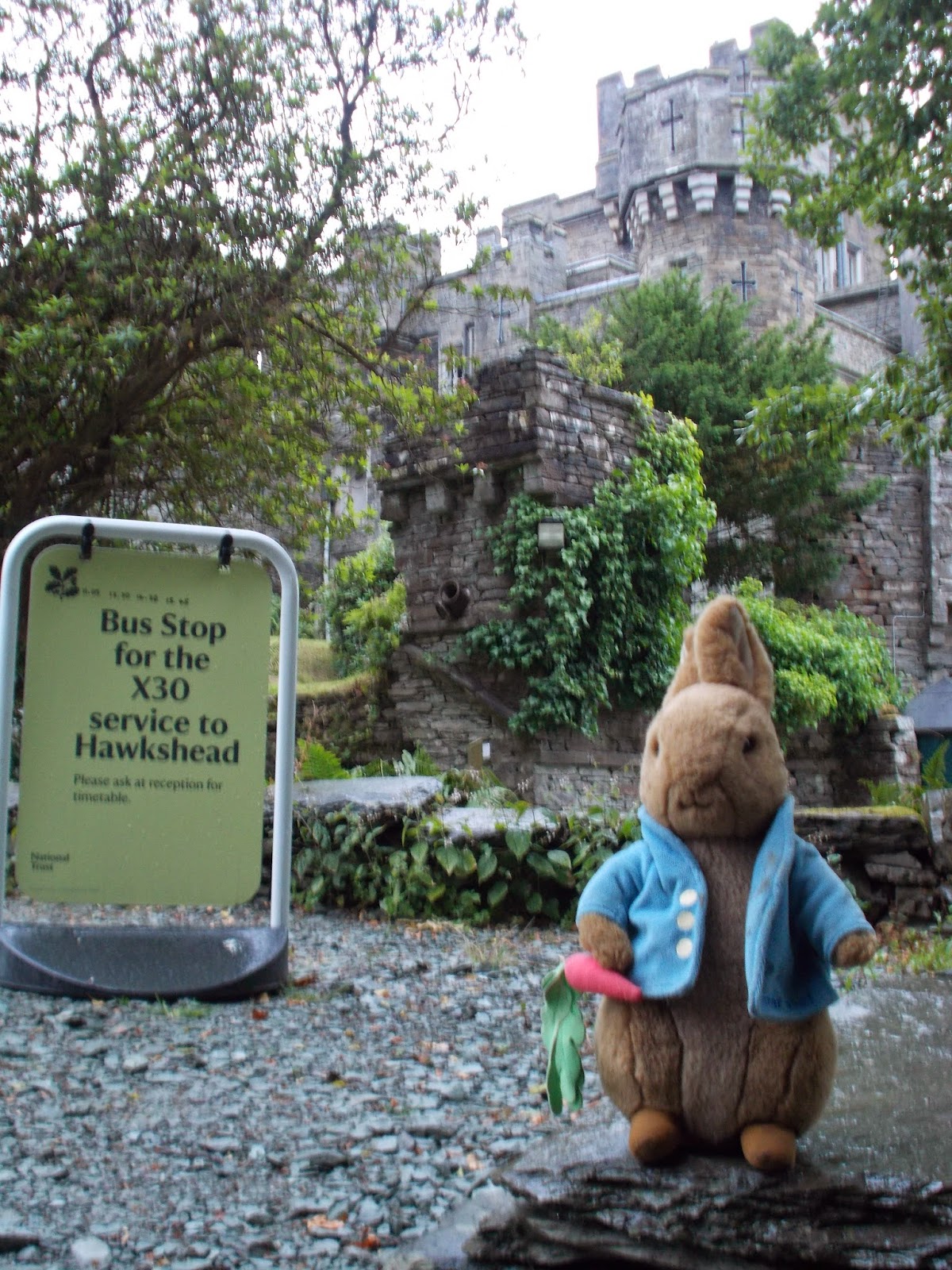
He wanted to see where Beatrix Potter first met the Lake District so he set out on the beautiful 4 mile walk along the lake shore to Wray Castle.

Beatrix Potter discovered the Lake District almost by mistake when her parents' regular holiday home in Scotland was unavailable.  She celebrated her 16th birthday at Wray Castle and fell in love with the area ....Maybe you will too!

Peter decided to explore the Castle.  The tour told him all about the castle and the link between Beatrix and one of the founders of the National Trust.  Then he had a play with some friends, built his own castle and polished off his picnic with some hot chocolate.

Then a quick scamper round the outdoor play area   ....

....Then on to discover more about Beatrix's passion and skills in sketching, drawing and painting at the Beatrix Potter Gallery in Hawkshead - but this time on the bus from Wray Castle.

The bus only takes 10 minutes and the service also runs to and from the ferry if you don't fancy the 4 mile walk Peter did. 

From the bus stop it's only a couple of minutes walk through the village to the Gallery.  Peter couldn't resist a visit to the National Trust shop.

Back to the bus stop and another 10 minute bus ride to Beatrix Potter's house, Hill Top.

The village of Near Sawrey is where Beatrix Potter settled and took refuge from the London life.  It is where she found inspiration for many of her little books.  It was as wonderful as Peter hoped and he managed to catch up with some old friends hopping around the orchard!


Peter had intended to finish his journey by following the footpath through the fields and down to the ferry but he fancied a cup of tea at the Tower Bank Arms which he remembered from reading the story of Jemima Puddleduck  ....


..so, after some refreshment, he caught the bus back to the ferry.

Why don't you follow in the steps of Beatrix Potter like Peter did?  If you're staying in Ambleside you can get a boat directly to Wray Castle.  Maybe Peter will try that on his next visit ...

Bye for now.

Enjoy your holidays  using your feet, bikes, boats and bus to explore!

12 July 2013

Frequently (and not so frequently) asked questions

What does everybody need when they arrive somewhere after a long journey?  You've guessed !

Question:  Where are the toilets?
Answer:  They're in the garden, half way up on the right hand side but subtly hidden and you may be distracted by the garden!


The Toilets 

The garden
And a not so frequently asked question- but it does happen!
Question: How long have you lived on this island?
Answer: We just get the map out for this.
Crossing to the 'island'
Question: Where was Beatrix Potter buried?
Answer: Beatrix was a very private person.  She was cremated and her ashes were scattered by her shepherd, Tom Storey, in a secret location.

Question: When is the quietest time to visit?
Answer: A hard one.  Generally it's quieter in the afternoons but at very busy times you may find we've sold out.  Saturday and Sunday afternoons are often surprisngly quiet.

Question: The car park's full.  What should I do?
Answer: A few options: - You could come back in a little while when there may be spaces - but please don't wait on the road.
There's a car park in Far Sawrey.  The 30 minute walk along the off road footpath gives you a great rural introduction to Hill Top.

If you click on this you should see a bigger version !
 There's more parking, and a Beatrix Potter trail, at the Esthwaite Fishery pay and display car park round the bottom end of Esthwaite Water - about 40 minute walk up.
National Trust car park at Ash Landing by the shore of Windermere and a lovely walk up - mainly off road and takes about an hour.
Sam on the footpath from Far Sawrey
Question: Referring to the Windermere car ferry - can I buy tickets for Ireland on the ferry?
Answer: Another one for the map!

Question: We've got some time to wait before going into the House.  What can we do?
Answer: Sawrey House Tearoom and the Tower Bank Arms pub can provide you with sustenance.  There's an excellent children's play area with picnic tables just down the road.  The walk to Moss Eccles Tarn, following in Beatrix's footsteps (it was one of her favourite places) takes about an hour. Go beyond the tarn to get fantastic views over to the Langdales.
Alternatively, you could get tickets for later in the day and fit in a visit to Wray Castle or the Beatrix Potter Gallery.

Play area

Sawrey House terrace

Moss Eccles Tarn
Water Lilies were Beatrix Potter's favourite flowers.  She planted a white one and a pink one in Moss Eccles tarn and they have since spread!  On her birthday, 28th July, we pick some from the tarn for the House
Question: Which is the nearest Underground Station? - Yes, it happened!
Answer: We'd guess Watford but ........ unless you're talking rabbit burrows of course!


Ticket Office Team

17 February 2012

In NT Retail - We're thinking about the summer already!

We may just have got rid of the snow but already we're planning for the months ahead - so what will you find in our shops this summer?

Our Guide

In our guide to spring & summer ranges 2012 you'll get a preview of what's coming onto our shelves; and find out how the South Lakes retail team is giving you great affordable quality along with the warm fuzzy glow from the chance to support our conservation work in the local area.


Visit our NT shops at Hill Top and Hawkshead, we're open 7 days a week.

post by Linda
2012 guide & photos by Melanie